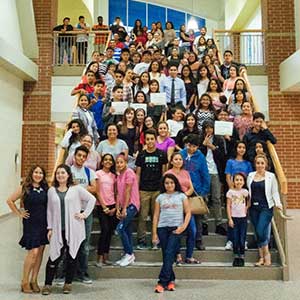

For Sofia, a Juntos 4-H’er and senior at Moreno Valley High School in California, it was not hard to notice how her school stood out for all the wrong reasons. “Every city has its sketchy areas, and my school… it is not high class like the other high schools.” She explained. If you step foot into another high school, it is a completely different sensation.” She shared.

Many of the neighborhoods that funnel into her school are less affluent than their surrounding areas. With almost seventeen percent of the population in the area living below the federal poverty line(Data USA), it is challenging for her school to provide the same resources to students as other schools in the area.“They [the other high schools] have a program that focuses on students and connects them with doctors and patients, and we are the only high school in the district that is not offered that program,” she explained. “It makes it seem as if we don’t get those opportunities because we probably won’t even make it to be a doctor.”

Sofia saw the lack of funding and limited program selections at her school that was directly affecting the perception of Latino students on their abilities to pursue higher education. To help Latino students gain more confidence in their educational potential, Sofia looked for a place where she could allow her community members to be heard. After Juntos 4-H was launched at her school, Sofia realized that she could use the program as an outlet to become more in touch with her community and it provided clarity about the power of her youth voice.

Sofia remembers how much her self-confidence increased and her connection with her community drastically improved after visiting UC Merced’s campus with her fellow Juntos 4-H members. “It allowed me to understand that I am worth value and anything is possible, even being Latino and part of the minority group,” she said. “I feel like just listening to everybody’s stories and how people suffer through immigration problems connected me more with the people of my own demographic.” This new bond with her community sparked a desire in Sofia to help her community address some of the issues regarding unequal educational opportunities she witnessed, especially knowing that she had the proper support from her Juntos family.

Sofia became president of Juntos 4-H at her school and used her leadership position to increase Latino advocacy in her district. She saw that doing so not only supported a positive impact in her school district, but also gave a newfound sense of confidence to other Juntos 4‑H members. Recently, Sofia and her fellow Juntos 4-H members spoke at to the Board of Supervisors at her City Hall about the importance of funding for the schools and programs in their community.

“Money was the issue, but the interest of the kids who want to continue these things and who want to see growth within themselves is priceless,” she said. For Sofia, bringing her peers and community together to advocate for themselves was empowering and something she sees as very valuable to the Latino community. She wants to continue to foster this in younger kids at her school.

Though the Juntos 4-H program was launched at her school under the original intent of encouraging Latino students to pursue a higher education after high school, Sofia believes that the program stems into a much larger context of uniting the Latino community and making them feel heard. “Juntos 4-H provides a home and a place in which you can safely feel like it is your community,” she explained. “It is so necessary for people to find somewhere to belong and to find somewhere to get their questions answered by a mentor.”

Sofia hopes to utilize her senior year as president of Juntos 4-H to expand its positive impact on her community to as many people as possible. She is making it a priority to make every one of the 76 percent Hispanic student population at her school feel safe and never feel deterred from pursuing their desires.

“For the upcoming year, I want to involve all the other students and makes sure that they know they have a safe place to communicate and are not scared of achieving new things,” she said. “I hope expanding the program gives more students, not only myself, an identity as to what the community is like and that there are actually people that care for them and that they have someone to relate to and trust.”
The partnership will provide young people with access to critical STEM education opportunities

Chevy Chase, MD (September 24, 2019) – National 4‑H Council today announced a $150,000 grant from the United States Air Force to expose more young people to science, technology, engineering, and math (STEM) education.

Through this partnership, communities in Colorado, Missouri, and Utah will receive free curriculum to implement 4‑H National Youth Science Day (4‑H NYSD), which is 4‑H’s signature STEM program that engages over 250,000 youth each year. This year’s 4‑H NYSD challenge, Game Changers, focuses on teaching computer science skills through fun activities like games and creating animations about causes kids care passionately about.

The grant will also support the training of teen leaders who will facilitate the high-quality, fun, and engaging activities for 4‑H youth. The teen leader experience will focus on career exploration and understanding real-world applications of STEM in the military like the technology of flight and cybersecurity.

“We’re excited to partner with 4‑H to emphasize STEM, teamwork, collaboration and the roles each play in the success of the U.S. Air Force,” said Major Ross McKnight, Chief, Air Force Experiential Marketing. “It is also important that we inspire the next generation of innovators and leaders in STEM to consider service in the U.S. Air Force as they pursue their skills and interest.”

By 2022, projections show that there will be more than nine million STEM jobs in the U.S., which represent a tremendous opportunity for teens beginning to plan for college and career. Through this partnership, 4‑Hers will be able to interact with airmen and see how STEM applies to every part of the United States Air Force’s mission and work in serving our country.

“4‑H NYSD gives young people the opportunity to learn foundational STEM concepts through fun, hands-on activities,” says Jennifer Sirangelo, president and CEO, National 4‑H Council. “To have a partner join us like the United States Air Force who can bring these concepts to life for our young people in a meaningful way is an incredible honor.”

To learn more about 4‑H National Youth Science Day, visit https://4‑H.org/NYSD.


About 4‑H

4‑H, the nation’s largest youth development organization, grows confident young people who are empowered for life today and prepared for career tomorrow. 4‑H programs empower nearly six million young people across the U.S. through experiences that develop critical life skills. 4‑H is the youth development program of our nation’s Cooperative Extension System and USDA, and serves every county and parish in the U.S. through a network of 110 public universities and more than 3000 local Extension offices. Globally, 4‑H collaborates with independent programs to empower one million youth in 50 countries. The research-backed 4‑H experience grows young people who are four times more likely to contribute to their communities; two times more likely to make healthier choices; two times more likely to be civically active; and two times more likely to participate in STEM programs.

Learn more about 4 H at https://4‑H.org, find us on Facebook at WWW.FACEBOOK.COM/4-H and on Twitter at HTTPS://TWITTER.COM/4H.

A little over 20 years ago, Lisa Borg started Ozark Miniature Tack and Equine Supplies. A lover of horses and all things equine, Lisa designed and offered quality equine supplies for minis and ponies. About two years ago, Ozark Mini Tack was purchased by State Line Tack, who not only saw a good business opportunity but great leadership and knowledge in Lisa.
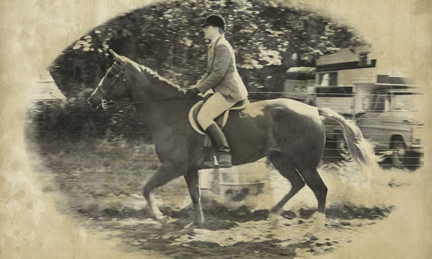
SLT-AlumniBlog-LBhorse

Today, Lisa is a member of the State Line Tack marketing team where she uses her equine industry knowledge to help State Line Tack connect with organizations who also want to support the equine community through experiences and education. National 4‑H Council is the newest organization to partner with State Line Tack, inspiring kids to jump to new heights through the partnership.

While there’s a clear connection between 4‑H and State Line Tack, Lisa connects with 4‑H on a more personal level.

She is a 4‑H Alumna.

Lisa’s parents immigrated to the United States from Denmark in the mid 1950s. In 1969, at the age of 8, Lisa was introduced to 4‑H. As her 4‑H experience began in Bellevue, Washington, she discovered what she truly loved – horses.

“[My mom] realized that 4‑H was a very American thing,” Lisa explained. “And 4‑H to her was the equivalent of what your child can do from start to finish.”

Like her mother, who grew up on a dairy farm, Lisa also understood the importance of valuing all animals, thanks in part to 4‑H. Because of the values learned in 4‑H, her mother spent what Lisa describes as “thousands and thousands of hours” driving her back and forth to 4‑H club meetings, events, and shows.

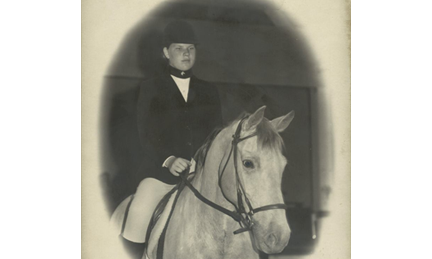
SLT-AlumniBlog-LBhorse-portrait
“She knew that 4‑H would help me in life,” Lisa says. “Back then, there wasn’t anything out there. And so for [my mom], it was really incredible that [4‑H] was a place that she can bring me. I was able to learn not only how to become a better student but be able to help me in my life. I could be the best person I could be because of 4‑H. There was no discrimination. We were all the same when we walked into that 4‑H meeting.”Lisa also remembers the connections she made through her 4‑H experience.

“We learned to rely on each other,” she recalls. “Even though we competed against each other, we rooted for each other, and we were always friends at the end.”

When remembering the friends she made, the skills she learned, and the opportunities she was fortunate enough to have, she stresses that those experiences would not have been possible without family.

“Without our parents, our family members, or whoever it is that’s taking us everywhere, it wouldn’t happen. I think we really need to acknowledge the fact that they helped us,” she says.

Because of the help she received, plus her 4‑H experience, Lisa went on to study International Business at Washington State University, traveled the world, and today, helps State Line Tack become a leader in equine supplies and education for all ages in all communities.

Through the 4‑H and State Line Tack partnership, Lisa hopes to create a local impact and help raise more awareness of 4‑H programs in communities where 4‑H may not be prevalent. Additionally, she wants more kids to experience what 4‑H has to offer, whether through equine programs, other livestock learning, and more.

SLT-AlumniBlog-LBjump (1)
“4‑H is great about providing educational opportunities for the kids. And it’s on an equal level. I think that’s one of the most important things. They understand what it means to win, to lose, to try again and again. There are so many different things that 4‑H does for kids and the future.”

Lisa credits 4‑H with teaching her so many of the valuable professional skills she still uses today including organization, presentations and time management. On a personal level, Lisa raises and shows Shetland ponies, and her first homebred world champion is now being well cared for and loved by a young 4‑H’er in Indiana.


About the Partnership

State Line Tack is a proud supporter of 4‑H’ers across America. National partners like State Line Tack help fund local equine programs and support National 4‑H Council’s mission to grow 4‑H from 6 million to 10 million kids across the country. Learn more about our partnership.

4‑H alumni are always eager to share their 4‑H story. It’s a proud moment as they recount their experience at 4‑H camp, attending and showing at their local Fair, or completing a 4‑H project. These experiences are what shaped them to become who they are today. Whether they’re farmers, educators, or small business owners, alumni credit 4‑H for giving them the skills needed to do what they are passionate about, both personally and professionally.

Through our partnership with American Farm Bureau Federation (AFBF), we seek to ignite the desire of young people to embrace agriculture, cultivate innovation, and empower them with opportunities to improve the world around them. These young people grow up to become Farm Bureau members at the county level and have stories of their own to share.

Meet Denise H., proud Louisiana 4‑H alumna.

Why was 4‑H important to you growing up?

DH: I was raised on a produce farm along with nine siblings. Our parents instilled in us great work ethics. We raised and grew everything we ate. So, there was not much time for after-school activities. 4‑H was the best opportunity for us to learn more about many of the things we were already doing as a family. My involvement in 4‑H allowed me to gain many leadership abilities that remain an important part of my life today.

How has 4‑H shaped who you are today?

DH: 4‑H was very instrumental in molding me into who I am today.  My interest in many things started at home; however, 4‑H was where I learned more, and it helped me build my confidence to participate in the many projects. It helped me build the confidence to become a leader, first by participating at the local level, then to participate at the state level. 4‑H helped me to find what my interests were and to grow those interests. It helped me become who I am today. I can say that without 4‑H, I never would have had the confidence to speak before a group. It was the start of a passion I have today, and that is to educate youth and adults about how their food is grown.

Are you still involved with 4‑H now?

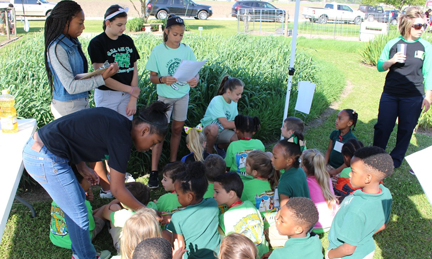
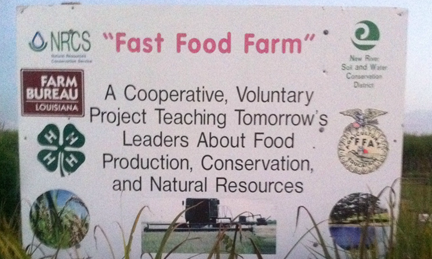
DH: I am still involved with 4‑H today. I don’t know if there was a time that I wasn’t involved in 4‑H in some form. I was heavily involved while my children were growing up through 4‑H. Later, assisted the 4‑H agents whenever they needed help after they graduated because my youngest never stopped working with 4‑H’ers either. I then formed a non-profit, the Fast Food Farm, where I work with 4‑H’ers and FFA students.  The goals of the Fast Food Farm are: to educate consumers of all ages about how their food is grown; create innovative educational materials to which teachers and students can relate; teach the importance of agriculture to our daily lives and to the economy; provide mentoring opportunities for all students; and provide leadership opportunities for 4‑H, FFA, and Pro-Start students. The students are trained to be peer teachers for the two large events we have at the farm each year. I serve on the St. James Parish 4‑H Foundation Board, as well as the Louisiana 4‑H Foundation Board.


From 4‑H to Farm Bureau: 4‑H was Where I Learned More

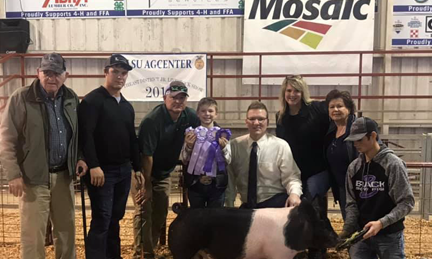
4-H-Livestock-Family-Winner
4-Hers-as-peer-teachers-St.-James-Parish-Ag-Day
Fast-Food-Farm
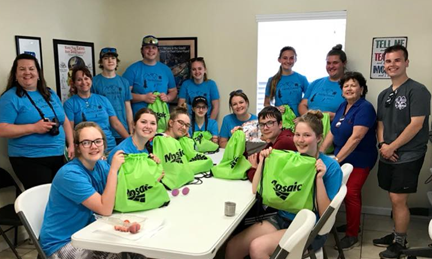
Hosted-Montana-4-Hers-Touring-Agriculture
Nutrition-Activitiy-in-Kids-Kitchen
St.-James-Parish-Ag-Day-Activity
4‑H alumni are always eager to share their 4‑H story. It’s a proud moment as they recount their experience at 4‑H camp, attending and showing at their local Fair, or completing a 4‑H project. These experiences are what shaped them to become who they are today. Whether they’re farmers, educators, or small business owners, alumni credit 4‑H for giving them the skills needed to do what they are passionate about, both personally and professionally.Through our partnership with American Farm Bureau Federation (AFBF), we seek to ignite the desire of young people to embrace agriculture, cultivate innovation, and empower them with opportunities to improve the world around them. These young people grow up to become Farm Bureau members at the county level and have stories of their own to share.

Lacey S., Nevada

I wouldn’t be who I am today without 4‑H. Growing up, I was a very shy young person. I wouldn’t ever dream about speaking to new people or in front of a crowd (unless it was a nightmare) until I joined 4‑H. I had an amazing 4‑H agent who encouraged me to join the horseless horse club to learn more about horses. The club also helped me work through my fear of horses due to a traumatic experience when I was a young child. I loved it so much, and it eventually helped me work through my fears and start riding horses again. That then started my mom to become a local 4‑H Horse leader for our valley. I was able to be a leader and start learning how to run meetings and encourage the younger members to be involved and engaged. I loved working with youth and agents from across the state, which helped me network and has helped me throughout my career. I also loved working with the younger kids in a camp setting, which cemented that I knew I wanted to work with youth no matter what in my future careers. The life lessons learned in 4‑H have helped in my life, and I love being able to pass on those life skills to my children. I am so thankful for the many opportunities and doors it opened up for me.

Megan D., Illinois

Like many of my peers, agriculture is in my blood, and 4‑H was the first organized outlet to meet others with similar interests and begin sharpening my skills. I have fond memories of Red Ranger club meetings where the adults truly let us become leaders and run a meeting. It also provided unique outings and taught me how to speak in front of a group through demonstrations. It was also something we did as a family. Meetings took place in our basement, and we worked together to finish projects, prep pigs for the show ring, and traveled 2.5 hours to the state fair to present award-winning rice crispy treats. 4‑H offered an outlet to express yourself through any interest. Today, I try to be a spokesman for agriculture at all levels. I remember some of my first experiences with the media were being at the Fair representing 4‑H. As an adult, I have been asked to do national media interviews and work directly with consumers and legislators.

Amy J., Virginia

I was raised in a very rural community. Growing up, 4‑H provided me opportunities to meet people outside of my community and experience different cultures. I also participated in leadership, citizenship, and community service activities that taught me the values of ethics, fairness, hard work, and commitment. My fair animal projects helped me save money to pay for my college education and establish a partnership with my dad buying and selling feeder cattle. Many of my memories growing up involve some type of 4‑H activity. I owe many of the skills that I have today to my time in 4‑H. As a nurse practitioner, I have to be able to multitask, think critically, and make strong decisions, sometimes very quickly, while having compassion, good listening skills, organization, and documentation skills. As a member of several director’s boards, I use meeting organization skills, parliamentary procedure, group organization, leadership, and strategic planning. After researching farm safety and injury prevention when I obtained my doctorate in graduate school, I am now a farm safety expert and I travel locally and nationally speaking on this topic. I am still involved in 4‑H today. I volunteer as a 4‑H leader in my local area, was an adult leader at 4‑H camp, served as a judge for district contests, served as a club leader for the Cloverbud Club, and assisted with special interest programs at the local level. I am a past president of the State 4‑H Leaders Association and remain on the state Board of Directors as the Central District President.

I’ve never missed a county fair in my life. In fact, I was almost born at one. My county fair will always hold a special place in my heart. I want to ensure all young people have the chance to participate – particularly three little boys in my life who have special needs.

Individuals who have special needs can participate in lots of activities – they just need support. Even I need support when it comes to some tasks in my life. I’m a big-picture thinker, which means I struggle to plan for small details in my life. That doesn’t mean I’m left to figure it out myself or fail. I simply ask for support.

My friend Jacob and my brothers Asher and Elias aren’t fortunate to have the verbal communication skills to ask for support when they need it, so I look for ways to support them based on their needs.

For my friend Jacob, support means two pairs of extra hands – a person to push his wheelchair and a person to keep the goat from eating its tires – and learning to use a device that helps him speak through pressing buttons. This requires teaching the goat to stay calm around a big, scary wheelchair. I also spend lots of time teaching Jacob all about his goat; what keeps it calm, what might scare it, what it eats, and how to name body parts when the judge asks.

My little brother Asher thrives on routine. To show a goat, Asher needs help developing a routine for moving around the show ring. Asher also has severely limited verbal communication. He and I spend much of our training time learning simple body parts he can point to and show the judge. We walk into the show ring with a laminated index card that tells the judge which questions Asher has practiced.

My youngest brother, Elias, has no trouble leading a goat much bigger than him. In the summer, he can often be found leading his goat and as many others up and down the driveway. Elias is more than strong enough to lead a goat in the right direction; he is ready to learn finer steps to goat showing. Fine-tuning, however, requires patience. Supporting Elias means teaching him that goats respond to gentleness and positive correction.

Through my involvement in 4‑H, I have been lucky to have a support system that encourages me to be a leader and help bring positive change to my community. Knowing I have a team of mentors and friends who are always there for me has given me the confidence to take on challenges and step out of my comfort zone to try new things. I encourage you to think about how you can provide support to those in your community – especially those who struggle to ask for it. You don’t have to have a degree in psychology or childhood development to figure out how to offer support. Often, support can come even in the smallest, simplest of things which can mean the world to an individual.

Chevy Chase, MD (June 24, 2019) National 4‑H Council is pleased to announce a collaborative partnership with Nationwide, one of the largest and strongest diversified insurance and financial services organizations in the United States, to build a diverse pipeline of youth leaders in agriculture with a commitment of $1 million through 2022.

The 4‑H Leaders in the Field program will help inspire youth to be active leaders in their community. In its pilot year, youth from Ohio will work with members of the Ohio Farm Bureau to refine and execute community action plans that address a need or challenge in their hometown. From strategic planning meetings to implementation, youth will be partnering with local Farm Bureau leaders to implement positive community change.

To hone their leadership skills, the grant will support scholarships for youth to attend Citizenship Washington Focus (CWF), 4‑H’s premier citizenship and leadership experience for youth. Held in Washington, D.C. each summer, CWF empowers high school students to practice and recognize the importance of civic and social responsibility by strengthening their leadership and citizenship skills. It prepares them for life; inspiring them to be invested, informed and accountable for generating the change they want to see in the world – and to create their own success in the future.

Support from Nationwide will provide sponsorships for three delegations of youth from Ohio to travel to the nation’s capital to experience hands-on educational workshops, tour Washington D.C.’s living classrooms and meet with members of Congress to build the skills to be active citizens back home and in their future agriculture-industry endeavors.

“We live in a time where agriculture, and its future leaders, are becoming more important than ever in the assurance of a safe, efficient and abundant food supply for generations to come,” said Mark Berven, President and COO, Nationwide Property and Casualty and National 4‑H Council board member. “By investing in the next generation of agricultural leaders, Nationwide and 4‑H are building a diverse leadership pipeline, lifting up our communities, strengthening grassroots relationships and empowering the youth of today to seek out positive change.”

As part of the 4‑H Leaders in the Field program, select Diversity in Ag Teen Ambassadors will participate in events with Nationwide to help engage a dialogue about today’s agriculture and ways that youth can make a positive impact. An Ag Teen Ambassador will also be featured in an upcoming 4‑H Day in the Life video featuring a celebrity 4‑H alum and NFL player who grew up working on his family’s cattle ranch.

“When young people take responsibility to find answers to challenges, extraordinary change happens – in youth themselves and in their communities,” said Jennifer Sirangelo, president and CEO, National 4‑H Council. “Opportunities like Citizenship Washington Focus help inspire active citizenship and position youth with the skills they need to succeed in their life and career.”


About 4‑H

4‑H, the nation’s largest youth development organization, grows confident young people who are empowered for life today and prepared for career tomorrow. 4‑H programs empower nearly 6 million young people across the U.S. through experiences that develop critical life skills. 4‑H is the youth development program of our nation’s Cooperative Extension System and USDA, and serves every county and parish in the U.S. through a network of 110 public universities and more than 3000 local Extension offices. The research-backed 4‑H experience grows young people who are four times more likely to contribute to their communities; two times more likely to make healthier choices; two times more likely to be civically active; and two times more likely to participate in STEM programs.

Learn more about 4‑H at www.4-h.org, find us on Facebook at www.facebook.com/4-h and follow us on Twitter at www.twitter.com/4h.


About Nationwide

Nationwide, a Fortune 100 company based in Columbus, Ohio, is one of the largest and strongest diversified insurance and financial services organizations in the United States. Nationwide is rated A+ by both A.M. Best and Standard & Poor’s. An industry leader in driving customer-focused innovation, Nationwide provides a full range of insurance and financial services products including auto, business, homeowners, farm and life insurance; public and private sector retirement plans, annuities and mutual funds; excess & surplus, specialty and surety; pet, motorcycle and boat insurance. For more information, visit www.nationwide.com. Follow us on Facebook and Twitter.

National 4-H Council and Google recently convened in Oklahoma to announce a new $6 million collaboration to bring computer science (CS) education to underserved youth across the country. This grant—part of Grow with Google’s efforts to ensure that everyone has access to future opportunities—will help provide more than 1 million youth across the country with computer science (CS) skills, plus computer science training for their educators over the next three years. There’s also a focus on rural youth and populations that have traditionally had limited access to CS education.

As a part of the announcement, Google and 4-H shared the story of Decklan Thomas, a high schooler from Bruceton Mills, West Virginia (population 86). Following three generations in the trucking industry, Decklan knew he was destined to follow the family tradition and pursue a career in the field.

Here’s a bit of his journey into computer science:

One day, Decklan learned about computer science through his local 4-H chapter. He didn’t even know he was coding at first—it just felt like solving a puzzle on the computer. As he began to do more coding, he quickly saw the parallels between the skills you need to be a mechanic and the computer science he was learning at 4-H. He says, “You see something wrong, then fix it—and end up with something amazing.” Decklan is still enthusiastic about becoming a diesel mechanic, but he’s now also exploring other opportunities like becoming a biomedical engineer or even going into the Navy. 

Brian Wendlandt, a Google Data Center Facilities Technician, also shared his 4-H story and how his experience in Oklahoma 4-H inspired where he is today:

I grew up going to my local 4-H chapter in Oklahoma. I loved learning about animal care, teamwork, and practical farm skills—a hallmark of 4-H. Like Decklan, those skills inspired me to learn how to fix things—I went to Oklahoma State University and went on to work for Google in Pryor. And I still fix things: the servers in our data centers that power our internet products for people across the country.

Wendlandt shares that he and Decklan are “representative of the many students across the United States who lack access to computer science learning opportunities.” With the creation of computer science-related jobs at nearly four times the rate of other jobs, students in small towns need more opportunities to discover and learn CS skills in classrooms and clubs at school, as well as introducing students and parent to CS opportunities outside of school.

“Together with 4-H, we believe in the potential of technology–and youth—to change and improve our lives, industries and communities,” Wendlandt says. “The Google.org grant will provide 4-H educators with the resources they need to ensure that students can access the skills they’ll need—both technical and non-technical—to create the technology that may improve our future.”


4-H and Google Inspire Kids to Discover Technology
A new $6 million grant from Google.org will help 4-H bring technology, resources and training to rural and underserved communities

Chevy Chase, MD (June 13, 2019) – Today National 4-H Council announced a new $6 million collaboration with Google to bring computer science (CS) education to underserved youth across the country. The collaboration will expand the 4-H Computer Science (CS) Career Pathway to reach more than one million youth over the next three years, with a focus on rural youth and populations that have traditionally had limited access to CS education.

Google’s support will build upon its prior investment of over $2 million in funding, to support training and resources which helped establish the 4-H CS Pathway that has reached over 325,000 youth since 2017. The collaboration combines the reach and educational expertise of 4-H, the nation’s largest youth development organization, and the power of Google’s CS products, educational programs, and employee volunteers who have dedicated more than 1,000 hours to support 4-H youth as they explore CS. Together, National 4-H Council and Google are laying the groundwork for 4-H to bring computer science education—and the opportunities for upward economic mobility it provides—to the 6 million kids it serves each year.

“While talent is everywhere, opportunity is not,” said Jennifer Sirangelo, president and CEO, National 4-H Council. “That’s why it’s so important to make sure young people everywhere have access to skill-building and mentorship opportunities that will inspire and empower them. This collaboration brings the opportunity to teach life-changing computer science skills to more young people across the country, giving them access to a productive and promising future.”

Delivering free computer science education to underserved communities is part of 4-H’s effort to provide equitable access to skills that help young people find success in life and career. Whether young people decide to take advantage of career opportunities in CS fields or put their talents to use in other disciplines, the skills they learn along the way—problem solving, digital fluency, creativity—will provide a strong foundation for success.

“We are excited to build on our work with 4-H with an additional $6 million grant to support computer science education in 4-H chapters across the country,” said Sundar Pichai, Google CEO. “With this grant, we aim to help more young people develop their coding and leadership skills that will put them on a path for future success.”

Google’s support will bring new CS education programs to communities across Alaska, Connecticut, Delaware, Kansas, Kentucky, Maryland, Massachusetts, Nebraska, New Jersey, North Carolina, North Dakota, Ohio, Oklahoma, Oregon and Virginia. It will also bring substantial resources to expand programming in California, Illinois, Indiana, New York and West Virginia. Read more about the initial collaboration that established the 4-H CS Pathway across 23 states.

About 4-H

4-H, the nation’s largest youth development organization, grows confident young people who are empowered for life today and prepared for career tomorrow. 4-H programs empower nearly six million young people across the U.S. through experiences that develop critical life skills. 4-H is the youth development program of our nation’s Cooperative Extension System and USDA, and serves every county and parish in the U.S. through a network of 110 public universities and more than 3,000 local Extension offices. Globally, 4-H collaborates with independent programs to empower one million youth in 50 countries. The research-backed 4-H experience grows young people who are four times more likely to contribute to their communities; two times more likely to make healthier choices; two times more likely to be civically active; and two times more likely to participate in STEM programs.

Learn more about 4-H at www.4-h.org, find us on Facebook at www.facebook.com/4h and on Twitter at https://twitter.com/4-H.

About Google.org

Google.org connects nonprofit innovators with Google resources to solve complex human challenges, and ensure that everyone can participate in the digital economy.

The same technology that makes our lives easier every day can also help solve some of the world’s largest problems. That’s why we’re applying advanced technology to some of our greatest challenges, like using artificial intelligence to help predict natural disasters. Everyone should be able to participate in the digital economy, so we’re providing digital skills training for job seekers, supporting online safety and media literacy, and investing in computer science education for students — particularly in underrepresented communities. We know that the best answers often come from those closest to the problem. That’s why we join forces with nonprofit innovators, committing Google volunteers, technology, and over $200 million in grants every year to help scale their impact.

To learn more about Google.org, please visit https://www.google.org.

I’m proud to be the 2019 4‑H Youth in Action Agriculture pillar winner (sponsored by Bayer). Since my friend Pearl and I founded our hunger relief project, Meating the Need for Our Village, five years ago, one of our guiding values has been to empower youth to make a change in their communities. To me, this award means a platform to encourage others to make change wherever they see fit, and I’m excited to give back to the organization that has shaped the person I am.

Staying true to my years of 4‑H experience, I made lifelong friendships and developed lasting support systems during my time at the National 4‑H Conference Center for YIA training and the Legacy Awards. Clyde Van Dyke, the 4‑H Youth in Action STEM winner, was the first 4‑H’er I met. Within seconds of saying hello, I found myself engulfed in a genuine “I’m happy to see you” hug. After minutes of conversation, I knew he was the real deal. The same held true shortly after when I met Mason McClintock and Elisabeth Watkins, the Civic Engagement and Healthy Living winners. Many more 4‑H’ers joined us for the Legacy Awards, and one thing bound us together: we were all the real deal. Every 4‑H’er I met was genuine and committed to pursuing their passions without question.

Of course, you can’t get too close to our nation’s capital without taking a monument tour, and the best tours have a tour guide. Who better than a 4‑H alum, Citizenship Washington Focus program assistant, and Youth Advisory Committee member? Noor Alshafie was incredible. She illustrated our tour with stories of Pierre L’Enfant and the building of our capital, as well as shared neat facts at each monument – complete with expertly crafted jokes. By the end of the day, Noor managed to make our group of teenagers and parents feel like a second family. I don’t know what she did, but I know 4‑H helped teach her how.

I’m a nerd. There’s no denying it, and yes, I’m going to blame 4‑H for that, too. Quite possibly my favorite part of our DC trip was our media training day. I’ve developed a love for agricultural communications, so it was exciting for me to work alongside National 4‑H Council’s communications professionals. Even though this day was technically our workday, there was never a dull moment because now, we were friends.

The capstone of our DC experience was the Legacy Awards. For that night, we dialed down the service-mindedness 4‑H taught us to never lose, because for that night, we were royalty. We met at the Ritz-Carlton Hotel and were led to a room stuffed with delicious refreshments to serve as our green room for the night. We put on our fancy outfits just before going to hair and makeup, and enjoyed an incredible night at the gala.

No 4‑H experience is complete without a late night with good friends you just met. That’s exactly how this trip ended – sitting around until the early hours of the day munching on now-cold pizza, reminiscing on our past 4‑H experiences. Hundreds of 4‑H experiences led to that night, each of them ending similarly. I wish my time as a 4‑H’er never came to an end, but when it does, I hope it ends like just like that.

4-H Youth in Action: The Real Deal