In memory of Elizabeth Weidner (2004-2021). Her adventurous spirit will live on and inspire us, forever.


September is Childhood Cancer Awareness Month, signified by the gold ribbon because children are as precious as gold. Cancer doesn’t discriminate; it can happen to and affect any child. This includes our 4-H families.  It happened to ours!

My journey hasn’t been easy, but one way I stayed focused was my involvement with 4-H.  During my bone marrow transplant for example, I was isolated in a children’s hospital in St. Louis where the occupational and physical therapists wanted me to play games or do Legos because “that’s what people usually do when recovering from transplant.” Instead I worked on 4-H projects.  Those projects kept me focused, brought me comfort, and gave me a purpose!

4-H groups can serve their own purpose while helping families in their communities who may be affected by cancer. Here are some ways you can bring help and provide assistance to those families in need.

Provide Basic Supplies: Partner with local hotels or civic clubs to collect and donate sample-sized toiletries and items to children’s hospitals or local Ronald McDonald Houses. Emergency trips happen, items get forgotten, and budgets are tight. From experience, these samples make a big difference.

Organize Blood Drives: Cancer patients go through a lot of blood products due to the toxicity of treatment on the individual.  Blood banks continue to experience critical shortages that affect the ability to supply hospitals and cancer center needs. Organizing a blood drive can’t offer 4-H members so many leadership opportunities that people don’t think about, like organizational skills. Saving lives is meaningful.

Support Siblings: As a patient, I can tell you siblings are often left out of the equation. Cancer affects the entire family.  Maybe your club could offer to adopt or do something nice for a cancer warrior’s siblings.  My brothers are into sports, so many have purchased athletic shoes or paid for uniforms, which is really helpful. Carpooling, showing up to events and cheering for them, and streaming games are a few other ideas that show siblings that someone cares.

Give Your Time through 4-H Projects: Something that doesn’t require money is the gift of time, especially if that time spent dedicated to a 4-H project or interest! Here are a few examples:

  • Do you have a talent such as photography? When budgets are tight or time is limited, professional family portraits are often neglected. Your 4-H photography project could give a cancer-family precious memories for the future.
  • Maybe you belong to a spin club that focuses on animals. My siblings love to go horseback riding but we don’t own horses. So a couple of local 4-H families donate their time to teach my brothers how to ride. That special time takes their minds off of missing our parents or thinking about what is happening in the hospital. Those experiences put smiles on faces where tears often reside!
  • Do you have members who want to learn how to sew? Try a Saturday service project learning the basics and creating pillowcases for children’s hospitals. Cotton fabrics work best, especially on oncology floors where linens are changed daily. A pillowcase, while it may seem simple, brightens sterile hospital rooms stitched in love.

Develop a Meal Train: A meal train is an organized meal giving system that allows you to donate a meal or request a meal delivery. Some families need daily help while others may choose specific dates that align with appointments.  For my mom, preparing a meal some days may be the last thing on her mind. Coming home to a home cooked meal, especially one that includes tried and true 4-H recipes brings true comfort to our family!

It’s easy to get overwhelmed at any age when you hear the words, “You have cancer,” but where we find hope is our community. Whether a community means where you reside, where you practice your faith, your 4-H family, or another group you belong to, it’s where we find our strength, how we move forward, and ultimately, what makes us survivors.

In 4‑H, we recognize that the Hispanic community consists of various groups representing different Latin American countries contributing significantly to the American mosaic. As we continue to grow, we are committed to strengthening our understanding of all the diverse communities we serve. This Hispanic Heritage Month, 4‑H honors and celebrates the Hispanic/Latinx youth, professionals and families within our community.

As a part of our celebration, we learn from our community of leaders within the 4‑H and Cooperative Extension system who foster a welcoming and inclusive space for Hispanic youth and families. Meet Laura Valencia, Extension Agent II, 4‑H Youth Development, University of Florida IFAS Extension, Dr. Lupita Fabregas, Director, Missouri 4‑H Center for Youth Development, and Liliana Vega, 4‑H Youth Development Advisor, University of California.

How does your 4‑H program engage Hispanic youth and their families/communities?


Laura Valencia (LV):
 As a 4‑H agent with UF/IFAS Extension Osceola County, my goal is to ensure our county’s diverse youth population has equitable access to the 4‑H youth development program. We accomplished that by providing a wide range of culturally relevant opportunities to our community (Osceola County is 55% Hispanic/Latino). For instance, Juntos 4‑H is a program that helps Latino youth in grades 8 to 12 and their families gain the knowledge and skills they need to bridge the gap between high school and higher education. Additionally, 4‑H Soccer for Success uses a holistic approach that looks at the child and the community to address the many barriers that prevent them from reaching their full potential. Lastly, 4‑H is improving the Osceola County community by helping children establish healthy habits and critical life skills by making these opportunities more accessible.

Lupita Fabregas (LF): In Missouri, we designed a strategy to engage new audiences—a road map. A holistic multilevel approach with specific actions taken by our team to create a culture of inclusion into their Extension programing. Those actions include: reviewing policies and procedures; marketing campaigns; redesigning job descriptions; redefining effort levels and specific growth objectives; selecting an Intercultural Competence framework to improve academic and staff intercultural competence; inclusion of the term ‘parity’ to reach new audiences; and selecting areas around the state with a larger Latino population. We also develop and grow programs like Soccer for Success and Juntos 4‑H to engage Latino communities. Lastly, we focus efforts on writing grants to support engaging new audiences while accepting the challenge of building an inclusive and engaging culture.

Liliana Vega (LVega): In San Luis Obispo/Santa Barbara County, we create culturally relevant and responsive youth programs for Latinx youth and families. This includes partnering with local community organizations to make youth programs are accessible and culturally appropriate to Latinx families. We also look for ways to bring the program to Latinx families rather than expecting them to come to us or come to a program if it is not inclusive of their needs. Lastly, we recognize that 4‑H can and should look different to meet the needs of Latinx youth and families to foster positive youth development and support a positive racial-ethnic identity.

Why is it essential to incorporate culture to foster a welcoming space for Hispanic youth and families?

LV:
 As a Youth Development Extension Agent, I play a crucial role in helping our youth feel like they belong, not just in our program but in their community. I know first-hand the difference creating a sense of belonging can make in a child’s life. When you belong, you feel safe. Today, amid national conversations about equity and inclusion, more than ever, youth need to know they are cared about by others and feel a sense of connection. Participating in experiences like 4‑H creates fellowship, gives the opportunity to feel physically and emotionally safe, and helps youth thrive.

LF: Culture is who we are and affects all aspects of our lives, from the food we eat to the kind of programs we would like to join. Latinos like me need to see our culture reflected in programs like 4‑H. From examples of programming that foster and appreciate our cultural values to welcoming communities that embrace our culture with respect and appreciation.

LVega: In all bodies of youth development research, research indicates the need to express care and foster a sense of belonging. For Latinx families, this includes welcoming their whole identities, including their culture, cultural values and customs, and racial and ethnic identities. For youth of color, developing and fostering a positive racial/ethnic identity is critical. The more we can help Latinx youth feel valued, respected, and welcomed, the more we ensure they have a positive sense of self, thus leading to positive youth development.

When I got involved in 4‑H at 12 years old, I had no idea how much I would learn about people, leadership, food insecurity, and the global needs around the world. I got involved in 4‑H to help start a community garden that would provide fresh fruits and vegetables to community members in need. Since then, I’ve developed a passion for addressing food insecurity and had a chance to do so on a global scale as the youth vice-chair for Action Track 1 for the United Nation’s Food Systems Summit (UNFSS), set to take place on September 23, 2020.

In the United States and worldwide, food systems are what we rely on to get the nutritious foods we need to thrive. Food systems include agriculture production, technology, food processing, public policy, distribution and resale, and consumers like you and me! The UNFSS is designed to engage people globally in conversations about food systems and how we can improve them for the future. As the youth vice-chair for Action Track 1, I’ve worked with a team from around the world to address how we can provide safe and nutritious food for all people across the globe. It’s been an amazing experience to hear and learn from world-class leaders who work every day to ensure all people have access to proper nutrition and aren’t going hungry!

I’m proud to have joined many young leaders from around the world to deliver a youth pledge at the UN Food Systems Summit in September. What we eat shapes us; it influences our health and well-being and impacts the environment. That’s why we started a movement called “Youth #Act4Food #Act4Change,” a global campaign to bring the signatures of thousands of young people across the world to the Summit, calling on leaders to bring significant change to our food system.

Through the youth pledge and other initiatives of the UNFSS, I hope that youth around the world will stand up and help bring actual change into our food system. As youth and future leaders, we are the people who will live on this planet the longest, and we want to ensure we have a healthy, safe planet that is ready to support the billions of people who live here for years to come. Our current food systems contribute to the ongoing health, climate and biodiversity crises, so we must work together to call for action amongst our world’s leaders.

Will you join me in pledging to act and calling on decision-makers to make changes that will lead to a thriving, sustainable food system? Sign the pledge today to uplift your voice. When we all work together, we can #Act4Food and #Act4Change to support #GoodFoodForAll!

The original singing competition and nation's largest youth organization to host an exclusive "Idol Across America" virtual audition day for 4-H singers on Friday, September 24

"American Idol" Returns for Season Five on ABC and 20th Season Overall in the Spring of 2022

CHEVY CHASE, MD (September 14, 2021) - 4-H is going to Hollywood! On Friday, September 24, the award-winning singing competition "American Idol" on ABC will host a dedicated, virtual audition day with 4-H, the largest youth development organization in the country. Through this collaboration with "American Idol" and National 4-H Council, 4-H singers nationwide will audition over Zoom for a chance to become America's next singing sensation.

"We are so excited to collaborate with our friends at 'American Idol' to create this once-in-a-lifetime opportunity for 4-H youth," said Ivan Heredia, SVP & Chief Marketing Officer, National 4-H Council. "This unique experience gives our incredible 4-H'ers the platform to showcase their talents and is an example of the many ways Cooperative Extension's 4-H program empowers young people to find their spark and pursue their passions."

Last season, Georgia 4-H alumnus, Willie Spence, was crowned runner-up on "American Idol" after delivering multiple powerful performances and wowing judges week after week. Hailing from Douglas, Georgia, Willie joined 4-H at age thirteen and became a breakout star of the 4-H performing arts group Clovers & Company.

"Competing on 'American Idol' was a life-changing experience that kick started my career in the entertainment industry," said last season's runner-up, Willie Spence. "There are so many impressive 4-H'ers who share my passion for music and performance. My message to all of them is to get out there and sing their hearts out at these auditions!"

To register for the 4-H Audition Day, visit https://bit.ly/Idol4H. Registration opened on Tuesday, September 14th at 9:00AM EST and closes on Friday, September 24th at 3:00PM EST. Full details on eligibility requirements, submission forms, terms and conditions are available at www.americanidol.com/auditions.

"American Idol" is produced by Fremantle and Industrial Media's 19 Entertainment. Executive producers include Megan Wolflick, also serving as showrunner, Fremantle's Jennifer Mullin and Trish Kinane with Eli Holzman and Aaron Saidman serving as executive producers for 19 Entertainment. Fremantle distributes the series worldwide.

ABC/Eric McCandless*

Georgia 4-H Alumnus Willie Spence covering Sam Cooke's "A Change is Gonna Come" during last season's "American Idol" finale on ABC.

About 4-H

4-H, the nation's largest youth development organization, grows confident young people who are empowered for life today and prepared for career tomorrow. 4-H programs empower nearly six million young people across the U.S. through experiences that develop critical life skills. 4-H is the youth development program of our nation's Cooperative Extension System and USDA and serves every county and parish in the U.S. through a network of 110 public universities and more than 3000 local Extension offices. Globally, 4-H collaborates with independent programs to empower one million youth in 50 countries. The research-backed 4-H experience grows young people who are four times more likely to contribute to their communities; two times more likely to make healthier choices; two times more likely to be civically active; and two times more likely to participate in STEM programs.

Learn more about 4-H at 4-H.org and follow us on Facebook, Instagram, and Twitter.

About American Idol

"American Idol," the iconic series that revolutionized the television landscape by pioneering the music competition genre, will return to airwaves for another season on ABC. Helping determine who America will ultimately vote for to become the next singing sensation are music industry forces and superstar judges Luke Bryan, Katy Perry and Lionel Richie. Emmy® Award-winning host and producer Ryan Seacrest will return to the beloved competition series as host.

Last season, ABC's "American Idol" ranked as the No. 1 series in its two-hour time period for the second year in a row among Adults 18-49. In addition, "American Idol" finished among the Top 5 unscripted series last season with Total Viewers (No. 4).

For more information on "American Idol," visit abc.com.

Follow "American Idol" (#americanidol) on Instagram, Twitter and Facebook.

Media Contacts

National 4-H Council
Julia Majors
jmajors@fourhcouncil.edu

For more information about "American Idol" please reach out to the below:

ABC Media Relations
Michaela Zukowski
michaela.zukowski@abc.com
Fremantle Publicity
Gigi Stevens
gigi.stevens@fremantle.com

On September 1, 2001, I moved to New York City to start a new job in the positive youth development field that I love so much.  Ten days later, our lives were changed by the attacks on the World Trade Center towers.  Here’s what I remember:

  • Looking out my 10th floor apartment window in the morning and seeing smoke billowing from the first tower.
  • Walking to NY Presbyterian Hospital to give blood. Seeing the doctors and nurses straining their eyes toward downtown and waiting outside in the emergency room driveway for ambulances to bring patients.
  • Spending hours dialing and re-dialing my cell phone to reach my family in Missouri because the cell phone antennas atop the World Trade Center were gone.
  • The quiet streets in NYC in the days after 9/11.  No cars, no people, just silence as the city mourned.
  • Second Avenue on 9/12 – empty of cars except for a miles-long line of yellow bulldozers and construction equipment heading to the WTC site like an excavation armada.
  • Adding my brownies to the huge potluck table of food from neighbors for the police officers and staff of the 13th Precinct who were working around the clock right on my block of 21st street.
  • The heroes – police, fire, EMT, Port Authority. Everyone giving them tremendous respect and appreciation for all they had done and all they had lost.
  • The horrible smell of all that was burning downtown and changing my air conditioner filters every week to get rid of the black soot.
  • So many people wanting to support the needs of kids through our organization during such a difficult time.
Most of all, I remember the overwhelming feeling of unity this tragedy brought to our country. As a new New Yorker, I tangibly felt the support of the entire nation and the world as we struggled to come to grips with what had happened. And I was determined to stick around to be part of the city’s recovery.

On this 20th anniversary, I realize that today’s 4-H’ers don’t remember 9/11. Thank goodness.  Our 4-H'ers and their peers in Gen Z are being shaped by other formative experiences – the pandemic, school shootings, racial injustice, and cyber-bullying.

After more than 20 years in this field, this anniversary of 9/11 is a reminder to me that every generation faces significant challenges. To build the resilience, confidence and connections needed to thrive, our young people need the mentors, leadership roles and skill-building that positive youth development organizations like 4-H provide.  Thanks to millions of Cooperative Extension staff, volunteers and supporters through the decades, 4-H has been here for every generation since 1902 and we will continue to be here for Gen Z and beyond. How thankful I am to be a part of such an important mission.

May each of us never forget the heroes who gave their lives for their neighbors on 9/11 or the lessons of that horrible day that inspire us to “pledge our hands to larger service for our clubs, community, country and world.”

During this year’s Global 4‑H Digital Summit, the inaugural Global 4‑H Youth Committee will be introduced, comprised of 15 young people to represent youth voices from each of the five 4‑H global regions. Among the three representing North America are two from the United States—Dylan Gentry and Katie Pascavis.

Get to know the two 4‑H U.S. members:

Dylan Gentry, Kentucky 4‑H

Dylan Gentry, raised in rural Central Kentucky, loves 4‑H and personal development. His experience in 4‑H culminated in 2018-2019 as he was elected Kentucky 4‑H Treasurer and awarded the title of Honorary Commissioner of Agriculture by current Kentucky Agriculture Commissioner, Dr. Ryan Quarles. In his last year of 4‑H eligibility, he was an ambassador for the States’ 4‑H International Program. As an ambassador, he traveled to Seattle, Washington, to orientate inbound Japanese and Korean youth before their yearlong foreign exchanges in America.

Dylan Gentry is a senior at the University of Kentucky, where he is pursuing a dual degree in Family Sciences and Community & Leadership Development. In addition, he has minors in Appalachian Studies and Agricultural Economics with a certificate in Business. Upon graduating in the spring of 2022, Dylan plans to attend law school and finish a doctoral program. With this extensive education, he hopes to better himself and his future job performance. His dream job is to work as an assistant dean for Extension or department director for 4‑H Youth Development at a land-grant university.

Dylan’s past work experience includes working under Dr. Rachel Noble as the state intern for 4‑H Leadership and International programs. As an intern, he authored the 2019 National State Officer Report, a first-of-its-kind report which reached out to all 50 states’ 4‑H programs to capture information about their state officer programs. He also co-authored 4‑H international programming curriculum focusing on the country of Brazil. Other experiences include interning under Dr. Jennifer Hunter, Assistant Director of Family and Consumer Sciences Extension. In addition, Dylan currently works part-time with the Globalizing Extension Innovation Network, where he works with Extension professionals to incorporate global perspectives into local programming opportunities.

Katie Pascavis, Illinois 4‑H / Arizona 4‑H

Katie Pascavis was raised in Bloomington, Illinois, and joined the 4‑H program when she was five years old as a Cloverbud, but she considers herself a 4‑H’er for life. As a 5th-generation 4‑H’er, the program is truly in her blood. Katie’s family moved to Arizona, where she continued her participation in 4‑H. She began organizing community service projects for her club, including local nursing home visits and food drives.

Katie served as President of the Queen Creek 4‑H Club and the State 4‑H Dog Committee, where she taught younger 4‑H’ers how to train dogs and small stock at weekly meetings. In addition, she started her county’s first 4‑H STEM project club. Katie was selected for the 2017 National 4‑H Congress Youth Leadership Team and was the Mistress of Ceremonies for the National 4‑H Gala. Through 4‑H, she competed in public speaking at National Western Roundup and represented Arizona at National 4‑H Conference. There, she worked with a team of 4‑H’ers to create a youth policy proposal that they presented to the U.S. Department of Health.

Currently, Katie is a junior at Arizona State University majoring in Mechanical Engineering and Global Health with a certificate in Sustainable Food Systems. She continues the 4‑H mission of service-learning through ASU’s Engineers Without Borders international team designing rainwater catchment systems. Katie is also a researcher for the Luminosity Lab, an interdisciplinary research and development lab on campus. In addition, she works on various COVID-19 response projects, including the XPRIZE Next Gen mask and the Fulbright Post-COVID challenge. Katie also continues to volunteer with both the Arizona and Illinois 4‑H programs.

Recently, Katie started as a Sustainability and Impact Analyst for Biomass Controls PBC, which provides eco-friendly solutions to global agricultural, water, and sanitation challenges. She aspires to focus her career on increasing access to clean water, food, and sanitation worldwide, a passion that she discovered through 4‑H.

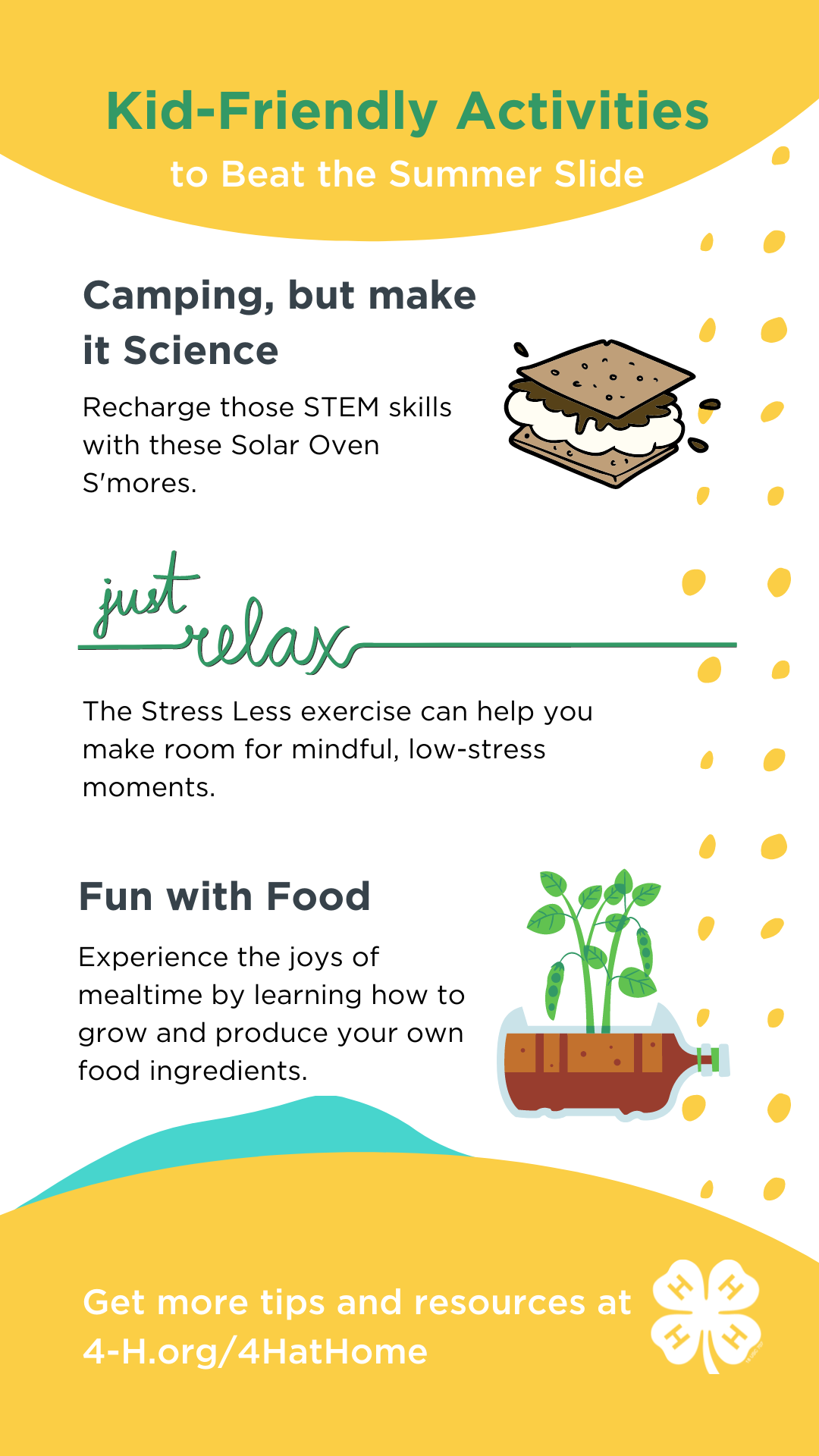
There’s still time to combat the summer slide with these kid-friendly tips and activities! They’re fun, safe, and sure to keep the kids sharp as the school year draws near.

summerslide-Blog-Infographics-image1


Traveling Reimagined


Couldn’t make that annual summer vacation this year? Now is the perfect time to learn about a place you’ve never visited before—like, say, rainforests! Try this 
Paint a Rainforest activity, courtesy of Utah State University Extension, to learn about and create a tropical jungle scene.

Fun with Food


Turn mealtime into a learning moment that the entire family can enjoy. Kids (and adults) can learn how to grow and produce food ingredients with this 
CLOVER collection of activities (brought to you by University of Alaska Fairbanks Cooperative Extension Service).

Slushie and Chill


Grab your favorite fresh—or frozen—fruits, a little bit of water or milk, add ice, and blend for a delicious and refreshing frozen drink. You can start with this 
Watermelon Slushie recipe (shared by 4‑H alum Elisabeth) and remix it however you want!

Marshmallows Out


Camping, but make it science! Recharge those STEM skills with these 
Solar Oven S’mores, courtesy of HughesNet.

Just Relaaax


A quiet mind and still body can surely bring some calmness to these last few days of summer. Need a little help managing your stress? This 
Stress Less exercise from The Allstate Foundation and Ohio State University Extension can help you identify daily high-stress activities and make room for more mindful, low-stress moments.

Data reveals that teens believe broadband access is critical to leveling the playing field for pandemic recovery and economic development in their communities.

CHEVY CHASE, Md., Aug. 12, 2021 -- A new survey by National 4-H Council, the Harris Poll, and the 4-H Tech Changemakers coalition-comprised of Land O'Lakes, Microsoft, Tractor Supply, and Verizon-found that teens believe disparities in access to high-speed internet and digital skills are continuing to drive economic and social inequities in their communities nationwide.

Survey results showed that unreliable access to high-speed internet, or internet that is either sometimes or never able to provide the services needed, is highly correlated to perceptions of reduced career prospects, significantly lower levels of digital literacy, and less confidence in the ability to be successful. With high-speed internet access becoming critical in the advancement of young people and local economies, 74 percent of teens (including 79 percent from rural communities) believe that the government should play an important role in providing broadband access to all.

Despite a rising need for high-speed internet, amplified by the impacts of COVID-19, the survey showed that access to reliable high-speed internet has fallen by eight percent over the last two years. Seventy-seven percent of youth had reliable access in 2019, compared with 69 percent in 2021, with Black youth lagging 10 percent behind the general population (59 percent of Black youth reported having reliable access).

The lack of access has significant effects on the lives of young people, with the survey results demonstrating notable differences in confidence levels between teens with and without access to high-speed internet in areas like graduating from high school (92 percent vs 89 percent), having a successful career (88 percent vs 81 percent), having financial success (85 percent vs 80 percent), and life overall (85 percent vs 74 percent). Unreliable internet access also leads to significant gaps in digital skills, despite widespread agreement among teens that "digital skills will be the key to getting the best jobs for my generation" (73 percent agree).

Unreliable broadband access also contributes to temporal inequity: for example, 50 percent of teens with reliable internet access spend three or more hours on homework each day. That number jumps to 62 percent for teens with unreliable access. The same pattern holds true with regard to accessing healthcare (19 percent vs 40 percent) and submitting job/college applications (26 percent vs 48 percent).

The survey also showed that unreliable broadband access has implications for adults across the country. A majority of teens agree that "access to broadband could have helped my community economically during the pandemic" (64 percent, 70 percent rural), and "if my community had better access to high-speed internet, people here would make more money" (63 percent).

These implications impact perceptions of future social and economic mobility as well. For example, 78 percent of teens believe it's possible for them to make more money than their parents, compared with just 67 percent of teens with unreliable broadband access. Teens with unreliable access were also less likely to believe that members of their community could receive a better education (40 percent vs 58 percent), make more money (49 percent vs 56 percent), access more career opportunities (40 percent vs 55 percent), or buy a home (35 percent vs 43 percent) than their parents.

The survey polled over 1,600 respondents in suburban, urban, and rural communities between the ages of 13-19 nationwide. The full survey results can be viewed at www.4-H.org/DigitalDivide.

"The data is clear: lack of access to reliable broadband and critical digital skills are some of the greatest barriers people face today in working toward educational and economic achievement. Expanding access to broadband internet and adoption of digital skills are concrete steps we can take now to drive more equitable access to opportunity across the country," said Jennifer Sirangelo, President and CEO of National 4-H Council. "Together with our Tech Changemakers partners, we're bringing critical digital skills to communities across the country, not only to create opportunities for individuals but to build local economies as well."

"Limited internet access in my rural community leaves students and business owners feeling behind the curve. The pandemic has worsened the situation since I'm now expected to complete many everyday tasks online, such as submitting schoolwork or job applications, even though I don't have reliable access to the internet," said 17-year-old Oklahoma 4-H'er Murphy Peterson. "My sister owns a small business but can't process orders or maintain the website at home. It's difficult to build a profitable business without this important resource. It creates a ripple effect for our economy because people are less likely to stay, start new businesses, and invest back in our community. Along with internet access, a program like 4-H Tech Changemakers would give 4-H'ers a chance to help communities like mine to grow and build a better future."

These findings show the profound impact reliable high-speed internet access and digital skills can have on the lives and futures of American teens and their communities. 4-H Tech Changemakers is National 4-H Council's initiative to help build a more equitable future through digital inclusion, with a focus on Black and rural communities. Made possible by support from Land O'Lakes, Microsoft, Tractor Supply, and Verizon, the 4-H Tech Changemakers program empowers teens to increase digital skills adoption in their communities by collaborating with coalition partners, local elected officials, nonprofits, educators, and businesses. Through 4-H's Cooperative Extension network, 20 Land-Grant Universities (LGUs), of which 11 are Historically Black Land Grant Colleges and Universities (HBCUs) will prepare 4-H teen leaders to teach critical digital skills to adults in their community. Tech Changemakers will reach an estimated 50,000 adults across 18 states with digital skills trainings in 2021.

About 4-H Tech Changemakers

4-H Tech Changemakers empowers young people to close the country's widening digital divide by providing them with the education and tools they need to teach digital employability skills, such as online job seeking, social media marketing and software use to adults in their communities. The program recently expanded its commitment to service more than 50,000 adults across 164 communities nationwide.

To learn more, visit 4-H Tech Changemakers.

About 4-H

4-H, the nation's largest youth development organization, grows confident young people who are empowered for life today and prepared for career tomorrow. 4-H programs empower nearly six million young people across the U.S. through experiences that develop critical life skills. 4-H is the youth development program of our nation's Cooperative Extension System and USDA and serves every county and parish in the U.S. through a network of 110 public universities and more than 3000 local Extension offices. Globally, 4-H collaborates with independent programs to empower one million youth in 50 countries. The research-backed 4-H experience grows young people who are four times more likely to contribute to their communities; two times more likely to make healthier choices; two times more likely to be civically active; and two times more likely to participate in STEM programs.

Learn more about 4-H at 4-H.org, find us on Facebook at Facebook.com/4-H and follow us on Twitter at Twitter.com/4H.

About Land O'Lakes, Inc.

Land O'Lakes, Inc., one of America's premier agribusiness and food companies, is a member-owned cooperative with industry-leading operations that span the spectrum from agricultural production to consumer foods. With 2020 annual sales of $14 billion, Land O'Lakes is one of the nation's largest cooperatives, ranking 219 on the Fortune 500. Building on a legacy of more than 100 years of operation, Land O'Lakes today operates some of the most respected brands in agribusiness and food production including Land O'Lakes Dairy Foods, Purina Animal Nutrition, WinField United and Truterra. The company does business in all 50 states and more than 60 countries. Land O'Lakes, Inc. corporate headquarters are located in Arden Hills, Minnesota.

About Verizon

Verizon Communications Inc. (NYSE, Nasdaq: VZ) was formed on June 30, 2000 and is one of the world's leading providers of technology, communications, information and entertainment products and services. Headquartered in New York City and with a presence around the world, Verizon generated revenues of $128.3 billion in 2020. The company offers data, video and voice services and solutions on its award-winning networks and platforms, delivering on customers' demand for mobility, reliable network connectivity, security and control.

Our world needs to solve big challenges in human health, agriculture, and food, and 4‑H is playing a critical role by cultivating the next generation of leaders in the agriculture industry. After the National 4‑H Youth Summit on Agri-Science this past March, teams of youth took part in the Dolphin Tank.

The Dolphin Tank”—a take on television’s Shark Tank—challenges teams of youth to develop Community Action Plans (CAP) that address a local agriculture issue in their community. The 4‑H-developed challenge provides experiences that lead to Positive Youth Development (PYD)* and sparks curiosity and discovery.

Teams were tasked with developing a written plan then pitching their ideas to ag industry leaders from Brightmark, CME Group, Farm Credit, National Corn Growers Association, Nationwide, New Holland, and Nutrien.

The highest ranked teams pitched their ideas for the opportunity to receive funds to put their plan into action. With support from Nationwide, Nutrien, and Brightmark, 24 teams from 17 states each received $1,000 to $2,000 to implement their Community Action Plan.

One of this year’s Dolphin Tank winning teams was the Eclectic Clovers Club, from Oregon State University Extension 4‑H. We got a chance to talk to Riley, a member of the team and a rising Junior at Zena Springs School in Polk County, Oregon, and Anne M. Walton, the team’s 4‑H leader, about their experience.

dolphintank-blog-image1


Riley and Anne, what inspired you to take part in the National 4‑H Summit on Agri-Science?

Riley: I have been interested in agriculture science since I was in elementary school, starting with dog training and an interest in vet school. After taking Junior Master Gardener classes I am now more focused on farm and forest. I was intrigued by the aspect of growing things that could benefit others, [like] a community garden or seed planning. In college, I want to get an engineering major and a military science minor. After college, I plan to specialize in biotechnology. Starting this project was really the opportunity to get my foot in the door and network with other people.

Anne: As a long time 4‑H Leader and Educator, I am always excited when 4‑H provides an avenue for young people to expand their knowledge and excitement about real world topics and careers.

Regarding your Summit experience, did you learn anything that surprised you?

Riley: I added to my existing knowledge of drone use in agriculture! I did not know how technologically advanced some of the drones could be for crops. This information from the speaker at Nutrien helped me develop my “Dolphin Tank” pitch.  Some of the newest drones can sense temperature fluctuations in different areas of crop fields, find and herd livestock, and ensure safety of workers in the field. Prior to starting this project, I did not know very much [about] aerospace technology and its use in farming.

Anne: For Riley, it was a great [opportunity] to attend the Summit and feel she wanted to try for a CAP Award. When she brought the idea to our survey group, the students got excited about the prospect of some support for advanced equipment to use in the project, and to be part of a national award interview.

What was it like working with your team for this program?

dolphintank-blog-image2

Riley:
For most of my group it was their first time doing a big presentation. We started by developing a list of what we wanted to cover in the proposal, then we got to work assigning people to topics based on what they were interested in. Once we got the script set in stone and the slides made, we practiced several times over Zoom.  The whole process took about a month.

Anne:
Part of our project survey area is managed by a private hardwood forest sawmill group from Willamette University and Oregon State University, so we had [several] scientists and foresters that we were already working with to bounce this award idea off of. My team members are great young people that I have already done projects with. We had been using a number of these survey techniques, learning the flora and fauna, and monitoring water levels and health on our own project grounds (my farm) for a couple years. So I felt they were ready to use these skills on a bigger scale and be able to give useful information to the neighboring properties.

What did you learn by preparing for and participating in the ‘Dolphin Tank’?

Riley:
I learned how to present large-scale information and data in the form of a proposal. I thought the presentation experience was very streamlined. I appreciated the feedback we received after we presented to the panel. For my team and I, seeing the panel of adults genuinely interested was very welcomed because it is never easy for youth to get adults to notice and pay attention to our ideas and concerns about our planet.Anne: When one decides to pursue an award like this, one does so with the intention of succeeding. I told Riley and the team that they made a great effort in their essay and interview, and that alone was a great learning experience. We really could not believe how exciting it was to win. We thank you so much for this tremendous opportunity!

*Positive Youth Development (PYD) is the cornerstone of the   4‑H model. PYD:

  • productively and constructively engages youth within their communities;
  • recognizes, utilizes, and enhances their strengths; and
  • promotes positive outcomes for them by providing opportunities, fostering positive relationships, and providing the support needed to build on their leadership strengths.
Young people have a vision for their future that takes root in their community. The homegrown experiences and hometown connections, many of which originate in rural communities, drive their personal and career growth journey. But far too often, those rural communities are forgotten, resulting in a lack of resources for basic, yet essential, needs like education, career opportunities and healthcare.The Rise of Rural Living, the Fall of Rural Resources

According to the 2018 U.S. Census, 30,000 millennials left large cities for rural living. As this generation continues to make its way back to small towns for a slower pace and peace of mind, things are looking up for those communities. However, a long-standing problem reveals itself—the digital divide.

According to the Federal Communications Commission (FCC), approximately 14.5 million people in rural communities don’t have access to high-speed broadband internet and millions more lack the digital skills needed to use it productively. In addition, teens today are feeling the strain from a lack of quality broadband. In a recent 4‑H study on the digital divide, 43% of rural teens surveyed plan to leave their hometowns and 34% of those teens cite poor internet connectivity as the reason. As a result, these towns are losing talent and future innovation. With a surge of young families and many students adjusting to a  digital learning environment, many rural communities risk falling behind.

Prioritizing Place-Based Investment

4‑H and Tractor Supply Company are investing in rural communities through skill development and community building. Collectively, our organizations meet young people in rural communities where they are by delivering resources to ensure they have the tools necessary to succeed in life and career.

Our partnership includes a bi-annual Paper Clover campaign which raises funds that directly impact the operations and continued growth (or impact) of local 4‑H programs.

Tractor Supply has supported 4‑H since 2010. The success of the Paper Clover fundraiser is a testament to the generosity and support of its team and customers for 4‑H’s mission.  The donated funds remain in the state so the young men and women in the communities Tractor Supply calls home have access to invaluable 4‑H experiences such as hands-on educational camps, conferences, and other leadership programs. The 2021 Spring Paper Clover campaign raised over $718,000 bringing our partnership total to more than $15 million in support.  This year was all the more important as students need funding to return to extracurricular activities safely amid the pandemic.

The American Connection Project is a collaboration of Tractor Supply, National 4‑H Council, Microsoft, Land O’ Lakes, and 150+ other industry-wide organizations which provides more than 2,800 free Wi-Fi locations nationwide. This innovative alliance was recently named a finalist for Fast Company’s 2021 World Changing Ideas Awards.—Access to these sites, including 1,200 Cooperative Extension offices and 1,400 Tractor Supply stores, ensures reliable broadband is available to communities that need it most.

As the nation’s largest youth development organization, led by America’s land-grant universities and Cooperative Extension System, 4‑H acts locally by meeting the needs of young people, no matter where they are. Our proven positive youth development programs are investments in rural communities that ensure all Americans have opportunities to grow and thrive. And youth are at the forefront of that growth. The expansion of the 4‑H Tech Changemakers program, which empowers young people to teach digital skills to adults in their community, is a vital step in preparing our future leaders and addressing the digital divide.

Eliminating the Opportunity Gap

To create a truly equitable and inclusive future for all, increased investments in rural communities are needed to close our country’s opportunity gap. Farmers, students, families, small business owners and entrepreneurs all depend on vital resources like high-speed internet access to connect and compete in a fast-changing economy. Tractor Supply and 4‑H are uniquely positioned to understand local needs and—as trusted household brands—develop national solutions.


Learn how 4‑H Tech Changemakers is empowering young people to close the digital divide.


Jennifer Sirangelo is the President and CEO of National 4‑H Council

Hal Lawton is the President and CEO of Tractor Supply Company