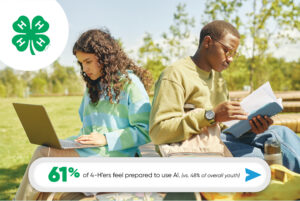





I’m a proud Pennsylvania 4-H alum whose nine-year journey with 4-H transformed me into a dynamic leader and passionate STEM advocate. With my sights set on a future in engineering and working for NASA, I’m just getting started. As a student in the Ben Franklin Scholars program at the University of Pennsylvania, it’s hard not to notice the influx of artificial intelligence. It pops up on our phones, computer screens, social media, and even when we order take out from our favorite restaurant. This tool transforms how we learn, work, and create.
And I’m glad to be a youth pioneer of AI.
Whether I’m trying to code an app to help my classmates manage their schedules or learning how to DJ for a friend’s graduation party, AI gives me a starting point and sticks with me as I progress. The emergence of new AI tools for productivity is especially thrilling. These tools help us organize, brainstorm, and create more efficiently than I did as a middle school student.
And it doesn’t stop there; seeing AI make its way into vehicles for autonomous driving or into robots that can assist with complex tasks makes me excited about how technology shapes the world around us. And it’s happening right before our eyes!
AI and Careers
When my friends and I talk about AI and our future careers, our conversations are a mix of excitement and real questions. We recognize that AI is groundbreaking and is already affecting every industry. On one hand, there’s a little anxiety, especially when we see how good AI is at analytical and administrative tasks. Earlier generations may have felt similar when the calculator was introduced to help enhance computing functions. It’s easy to imagine a future where employers hire AI virtual agents to speed up efficiency.
At the same time, the mood is hopeful. For many of us, AI means we can spend less time on repetitive tasks and more time tackling big, creative challenges. AI is opening up a whole new toolbox for young leaders, helping us turn our ideas into reality.
Threat or Opportunity? Maybe Both.
There’s no denying AI will change the job landscape, and yes, some jobs may be replaced. I’ve read that AI could be one of the first technologies to impact white-collar workers, including managers, because it can communicate and execute tasks quickly and efficiently. But that’s only part of the story.
AI also brings a new horizon of opportunity that can be done right from home. For example, when my family’s microwave needed a new part, I used AI to create a 3-D model of the part. When it was assembled with the newly created part, it worked!
My Vision for AI in My Career
When I picture my career 10 or 15 years from now, I see AI woven into everything I do. I imagine AI proofreading my emails, reading through my email inbox to highlight the most important information, and brainstorm and evaluate ideas as I work on engineering projects. As I begin my journey as an engineering freshman, AI will be my creative partner, speeding up the path from idea to solution and helping me make a positive impact in my community.
How 4-H Has Prepared Me for an AI World
The world is changing fast, and the skills we need are shifting, too. Today, qualities like adaptability, creative thinking, and quick learning are skills employers say they need in the workforce. 4-H has been my outlet for building these skills, through clubs, hands-on projects, and mentorship from passionate educators.
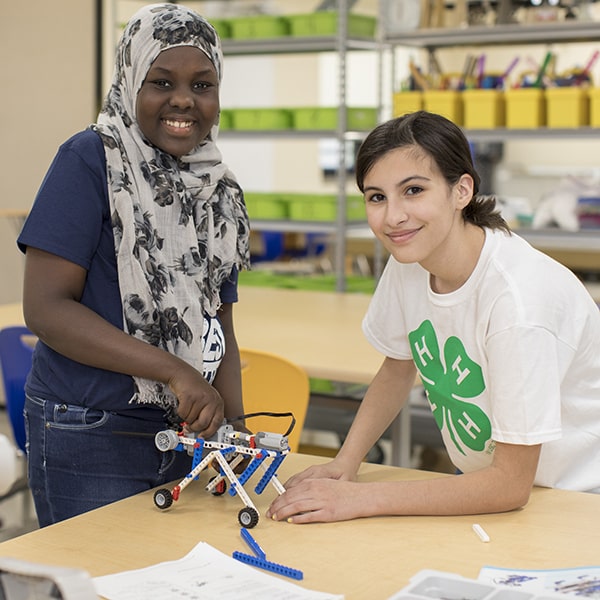
4-H gave me real-world experiences that challenged me to grow: competing on a robotics team, stepping up for public speaking competitions, and serving as a National 4-H Youth in Action spokesperson to inspire younger youth. I’ve learned how to solve problems, work with others, and present my ideas with confidence, all essential skills for thriving in an AI-driven world. Recently, I was on a panel with Microsoft leaders discussing the future of AI. It’s opportunities like these that 4-H provides that help prepare me for the future.
About Ronak Suchindra
A proud Pennsylvania 4-H alum whose nine-year journey with 4-H transformed him into a dynamic leader and passionate STEM advocate. With his sights set on a future in engineering and dreams of working for NASA, he’s just getting started. National 4-H Council asked Ronak to share his thoughts on the future of AI for this blog post.