



America’s young people are hopeful about what lies ahead. They understand what skills matter for success. With the right experiences, that optimism and knowledge can translate into a future-ready workforce. 4-H is closing the divide between knowing and doing through hands-on learning, mentorships, and career-connected programs.
The 2025 Youth Voice Survey, conducted by National 4-H Council and Hart Research, reveals a clear picture. While teens are aware of the skills they need to succeed, many don’t feel prepared to apply them in adulthood and the modern economy.


By the Numbers
80% of teens feel optimistic about the future. Among 4-H’ers, that number jumps to 87%, underscoring how out-of-school experiences help bridge the readiness divide and create opportunities for business, education, and community leaders to hire employees who are prepared for work.
Young people recognize that financial skills matter:
- 73% say managing money is essential; however
- Only 47% feel prepared to handle finances day-to-day
Mental health is just as critical:
- 72% say managing stress and mental health is important to success
- Only 48% feel ready
4-H’ers are:
- 40% more likely to pursue a college degree
- 2X more likely to obtain vocational or technical training
- 2X more likely to serve in the military
Additionally, nearly 1 in 4 youth in 4-H say they’re interested in pursuing a career in agriculture, a field that has one qualified person for every two open positions.
Young people face real pressure from school, social media, and future planning. When they learn to manage stress and support their mental well-being, they become stronger leaders and are better prepared for whatever comes next.
Youth also recognize the need for technical skills in data and analytics (52%), writing (50%), computer technology (47%), and math (45%). The good news? Young people recognize the importance and feel confident in communication, teamwork, leadership, and critical thinking skills---all skills that employers consistently say they value.
“Today’s teens are not disengaged or indifferent; they are wide awake to the world around them,” said Jill Bramble, president and CEO of National 4-H Council. “While much of the national conversation is focused on the challenges facing young people, these findings point to something different: a generation that is motivated, values-driven, and optimistic. What they lack isn’t awareness, it’s access to the kinds of experiences that turn awareness into readiness. At 4-H, we’re providing hands-on experiences to help them become Beyond Ready for the future.”
Preparing For the AI Workforce
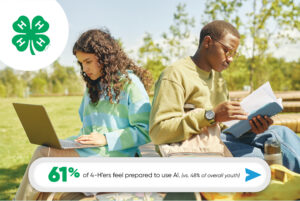
Artificial intelligence (AI) is reshaping every industry. Young people are anticipating how it will impact their future careers. 88% of teens anticipate they will need AI skills in their future work, with 53% saying they feel ready to use AI tools and 35% saying they are not prepared to use them effectively, according to the youth survey results.
These findings suggest that young people recognize AI as a critical workforce skill, but many lack hands-on opportunities to build confidence and fluency.
Employers agree. The World Economic Forum’s Future of Jobs Report 2025 highlights that employers across industries increasingly rank AI literacy, analytical thinking, and technological fluency among the most important skills for the future workforce, alongside adaptability and leadership. AI readiness is no longer optional, it’s necessary.
Beyond AI, employers consistently report that success in the modern workforce depends on a combination of work-readiness and technical skills.
According to the U.S. Chamber of Commerce’s New Hire Readiness Report 2025, businesses look for communication and collaboration, critical thinking and problem-solving, adaptability and resilience, along with technical and digital skills. Many employers say high school graduates need additional skill-building before entering the workforce.
How 4-H Closes the Divide
The Beyond Ready initiative addresses these issues by helping young people become healthy, productive, and engaged through hands-on, career-connected learning like building confidence through fair presentations, immersive virtual learning on 4-H CLOVER, and completing challenges focused on career and community interests like AI.
Through 4-H, youth gain:
- Real-world problem-solving experience
- Exposure to emerging technologies and industries
- Mentorship from caring adults
- Leadership and community engagement opportunities
The experiences through 4-H help youth move from understanding which skills matter to confidently applying them in real-world scenarios.
Furthermore, The 2025 National 4-H Index Study examined readiness outcomes among 7,369 4-H’ers nationwide.
The results show clear growth from previous studies:
- 92% report acting professionally
- 91% show persistence
- 76% feel ready for college and career
The study measured 4-H program quality alongside outcomes tied to work readiness, college and career pathways, leadership, STEM, and being healthy, productive, and engaged — providing a deeper look at how 4-H experiences translate into real-world preparedness.
The results run parallel to the 2025 Youth Voice Survey findings, reinforcing that 4-H’ers are more prepared to navigate what comes next.
A Real-Life Example
Eighteen-year-old Esther Bonney exemplifies how access and mentorship translate into readiness.
With support from University of Maryland Extension mentors and a 4-H Lead to Change Grant, Esther launched Nurture Natives, a youth-led nonprofit addressing agricultural and food insecurity.
“4-H helped me gain my footing through leadership programs, community engagement opportunities, and adult mentorship. It helped restore my sense of purpose, so my future is clear.”
Now majoring in environmental science and policy on a pre-law track, Esther continues to apply leadership, critical thinking, and problem-solving skills — the same competencies youth and employers alike identify as essential.
What Comes Next
Teens are ready to lead. They’re optimistic. They know what skills matter. What they need is access to real experiences that build confidence and readiness.
4-H is providing that pathway. Through Beyond Ready, 4-H will prepare 10 million young people for work and life by 2030.
About the Survey: The 2025 Youth Voice Survey was conducted online by Hart Research from August 6-20, 2025, among 1,126 youth ages 13-18, including 216 4-H participants.